

A management compromise can reach beyond the application
CVE-2026-133469 bypasses authentication in the Xen Orchestra REST API. A token type-validation error can associate a request with the owner of an existing, unexpired token. Vates rates the issue Critical and describes the possibility of administrative actions. This article does not reproduce the attack procedure.
The vendor confirms real-world exploitation and has published indicators of compromise. CISA added the vulnerability to KEV on 25 November 2026. Control of Xen Orchestra can lead to code execution on managed pools and root takeover of XCP-ng nodes. Organisational exposure therefore includes virtual machines, service availability and credentials used to operate backups.
Management access expands the potential incident scope
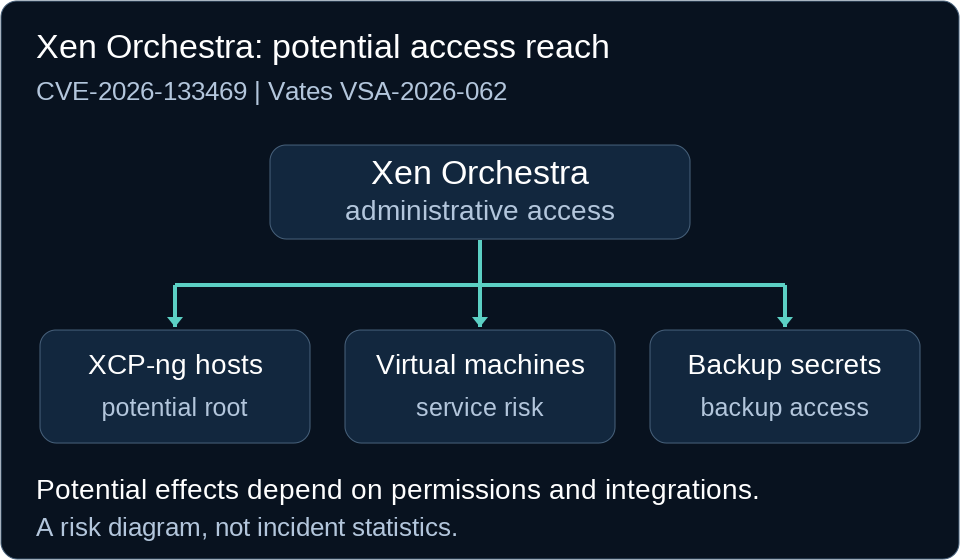
The diagram illustrates how access may extend following a Xen Orchestra compromise. It does not mean every installation suffered attacks on all hosts or backup deletion. Actual scope depends on integrations, permissions and incident findings.
Match the fix to the update channel
Vates identifies Xen Orchestra 6.9.2 on stable and 6.10.1 on latest as fixed releases. Their corresponding xo-server packages are 5.211.2 and 5.213.1. Do not confuse the full release number with the package version. Xen Orchestra Appliance also requires an update. For source installations, the vendor recommends current master; confirm code provenance and the installation's maintenance process before changing it.
Record the installed version, channel and update date. Check every instance, including standby and test systems with production access. Restricting management to a dedicated network reduces exposure but does not replace the fix or a review of earlier activity.
Check hosts and preserve investigation evidence
Vates warns that a successful authentication bypass may leave no corresponding application log entry. Its indicators include a VM named pivot2, unusual VM serial-port configuration and host persistence artefacts. The following commands are read-only. Run them within an agreed scope, preserve results and avoid deleting suspicious files before investigation.
xe vm-list params=name-label,platform
zgrep -- '-serial file:' /var/log/xensource.log*
ls -la /etc/ld.so.preload /.ustar* /etc/cron.d/zz-ustar*
Compare results with the current advisory and known environment configuration. A missing-file error is not evidence of safety. These indicators cover the campaign described by Vates; another actor may leave different traces. Review administrative operations, new accounts and tokens, and available network logs covering the exposure period.
Our recommendations:
Restrict management access and determine whether compromise occurred while preparing the update. For a confirmed intrusion, Vates recommends full reinstallation because cleanup alone cannot guarantee removal of every backdoor. Preserve evidence before rebuilding and avoid restoring unverified configuration.
From a trusted environment, plan rotation of passwords and secrets reachable from Xen Orchestra, including host accounts, tokens, the pool secret and remote backup repository credentials. Verify backup integrity and recovery capability outside the compromised management plane. After remediation, confirm the version, network restrictions and log delivery to an independent system.
What the evidence establishes
KEV records forensicTriage: Yes and ransomware: Unknown. This does not establish a ransomware campaign or victim count. The 28 November 2026 deadline applies to the relevant US federal agencies, not automatically to Polish businesses. Sources were checked on 26 November.
Sources
- Vates VSA-2026-062: advisory, fixes and incident responseSource date: 2026-11-10. Source updated: 2026-11-10. Checked: 2026-11-26.
- CVE Program: CVE-2026-133469Checked: 2026-11-26.
- CISA KEV: official catalog 2026.11.25Source updated: 2026-11-25. Checked: 2026-11-26.
Checked VSA-2026-062, CVE Program and full KEV 2026.11.25 on 26 November. Vates and CISA confirm exploitation. The diagram shows potential privilege reach, not a documented number of compromised hosts. Public-source analysis, not original LS Core research.