

Five KEV entries concern one component
On 25 November 2026, CISA added five Mitel MiCollab Audio, Web and Video Conferencing (AWV) vulnerabilities to KEV. They cover file upload, XML and command injection, information access and authentication bypass. Mitel documents them in MISA-2026-0012, first published on 16 November and updated to revision 2.0 on 24 November.
A communications platform may be Internet-accessible while also connected to internal resources. Potential consequences include data exposure, application changes and communications outages. KEV confirms exploitation of each flaw but does not establish that all five formed a single attack chain or have identical impact.
Different preconditions and consequences
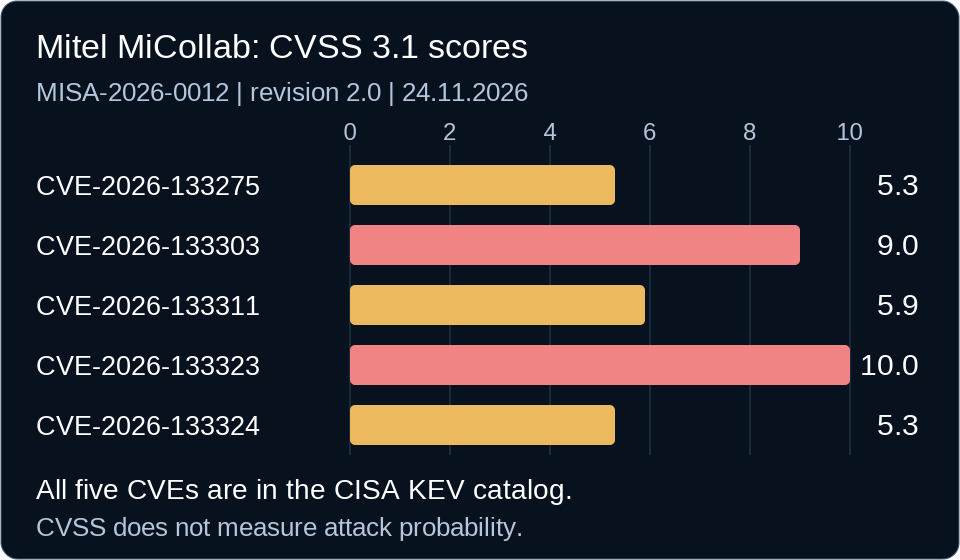
CVE-2026-133275 allows unauthenticated upload of insufficiently validated files; Mitel scores it 5.3. CVE-2026-133303 is XML injection that can execute commands using pre-staged malicious content, scored 9.0. CVE-2026-133311 exposes information when a specific random identifier or pre-staged content is known, scored 5.9. It does not provide unrestricted access to arbitrary system files.
CVE-2026-133323 is blind command injection scored 10.0, while CVE-2026-133324 bypasses application authentication and is scored 5.3. All figures are Mitel CVSS 3.1 base scores. A base score does not measure attack frequency. Confirmed exploitation makes medium-rated flaws operationally important too.
Version 10.3.0.18 needs the additional security patch
Mitel lists MiCollab 10.3 (10.3.0.18) and earlier as affected. It recommends upgrading to 10.3.0.18 and applying the dedicated patch, or moving to a later release that includes the fixes. Seeing 10.3.0.18 in the version field does not establish remediation.
Installation instructions are in KB000129195. Contact a Mitel Authorized Partner if access is unavailable. We do not supply an unverified package name or procedure from the restricted portal. Establish application state, dependencies and recovery steps before changing it; afterwards, confirm actual patch installation and test calls and conferences.
Our recommendations:
Inventory MiCollab instances and AWV exposure. Apply the appropriate fix in an agreed maintenance window. If immediate updating is impossible, Mitel identifies restricting external AWV access as a mitigation. Assess remote-user impact and provide controlled access without disabling other protections.
Preserve application, web and administrative logs. Review unexpected uploaded files, configuration changes, accounts and processes against known history. If compromise is suspected, preserve evidence and begin incident response. A patch closes the flaw but does not establish removal of prior access or absence of data loss.
CISA deadlines and triage flags differ
KEV gives 28 November for CVE-2026-133275, CVE-2026-133303, CVE-2026-133323 and CVE-2026-133324; CVE-2026-133311 is due on 9 December 2026. forensicTriage: Yes applies to 133303 and 133323; the others record No. All record ransomware: Unknown. These deadlines apply to relevant US federal agencies and are not automatically statutory deadlines for Polish organisations.
Sources
- Mitel MISA-2026-0012, revision 2.0Source date: 2026-11-16. Source updated: 2026-11-24. Checked: 2026-11-26.
- CVE Program: CVE-2026-133275Checked: 2026-11-26.
- CVE Program: CVE-2026-133303Checked: 2026-11-26.
- CVE Program: CVE-2026-133311Checked: 2026-11-26.
- CVE Program: CVE-2026-133323Checked: 2026-11-26.
- CVE Program: CVE-2026-133324Checked: 2026-11-26.
- CISA KEV: official catalog 2026.11.25Source updated: 2026-11-25. Checked: 2026-11-26.
Checked MISA-2026-0012 revision 2.0 of 24 November, five CVE records and full KEV on 26 November. All five were added on 25 November; no shared attack chain is assumed. The chart reproduces vendor CVSS 3.1 scores, not breach likelihood. Restricted KB000129195 was not read. Public sources, not original LS Core research.