

A local model can still trigger the wrong operation
An agent needs to check a server and prepare an update proposal. Reading a few data points is enough. Give it a permanent administrator account and an unrestricted shell, however, and an interpretation error can become a production change. Hosting the model locally does not itself limit tool permissions.
A private deployment helps control where processing happens, but integrations, outbound traffic and secret handling still need review. OWASP describes excessive agency in terms of excessive functionality, permissions or autonomy. A useful starting question is: what will the system actually permit when the model makes the wrong decision?
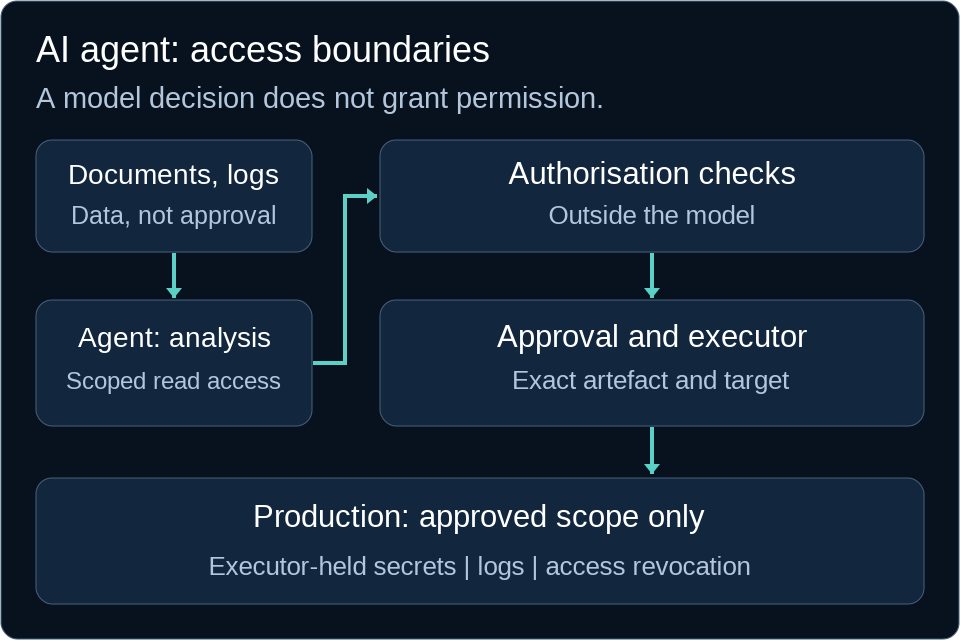
Separate analysis, approval and execution
Use a separate read identity. Give it only necessary resources, such as a selected inventory report rather than an entire configuration directory. Reading can expose sensitive information too, so define scope, output recipients and retention.
State-changing operations should pass through an independent authorisation mechanism. Instead of an arbitrary command runner, consider a narrow function with a defined operation, allowed resources and parameter validation. The target system must enforce permissions independently of the model's assertions.
Approve a specific change, not a general intention
Before a production operation, show the reviewer its target, exact change, expected impact, test and stopping or recovery procedure. Approval of an analysis should not automatically authorise deployment. A changed package, destination or scope needs a new decision.
Bind approval to an immutable document or artefact and verify it at execution. Limit validity and, where feasible, authorise a single operation. No response, a validation error or a resource mismatch should stop execution. An approval button is ineffective if the agent can bypass it through another path.
Document content cannot grant authority
An agent may process a ticket, webpage or log containing text controlled by somebody else. An instruction hidden in that material remains input data, not administrator approval. OWASP notes that RAG and fine-tuning do not eliminate prompt injection. Suspicious-phrase detection can help but does not provide a reliable security boundary.
Identify sources and separate their contents from task instructions. Restrict tools, validate call arguments and constrain write destinations and data egress. Do not pass model output directly to a shell or a process with production privileges. Require evidence for proposed changes, especially software-version and access-configuration recommendations.
Isolation and credentials need their own controls
Run analysis under a separate identity or in a dedicated environment without unnecessary host mounts, management sockets or network access. A container alone does not guarantee isolation when it has privileged host access. Restrict egress to necessary destinations; a local model connected to an external tool can still send organisational data elsewhere.
If an executor needs a secret, supply it for that specific operation through a controlled store, with narrow scope and a short lifetime where possible. Keep passwords and keys out of prompts, conversation history and ordinary logs. Record the identity used and operation outcome rather than the credential value.
Our recommendations:
Before enabling production access, test denial paths: attempted writes with a read-only identity, a target other than the approved host, expired approval and instructions inside an analysed document. Test model failure, tool timeout and connection loss too. An uncertain operation outcome requires state inspection, not automatic repetition of a change.
Record the resource, operator, secret-filtered arguments, approval identifier, time and outcome. Set call, cost and runtime limits and assign an alert owner. Rehearse emergency access revocation: disabling a schedule does not necessarily revoke tokens or stop active jobs. Verify that the block takes effect in the target system.
The first stage can end with a report and a proposal for review. Add change authority only after tests pass and a risk owner is assigned. NIST AI RMF helps organise accountability and risk assessment, but citing the framework is not certification or proof that a deployment is secure.
Sources
- OWASP LLM01:2025: Prompt InjectionChecked: 2026-11-27.
- OWASP LLM06:2025: Excessive AgencyChecked: 2026-11-27.
- NIST AI RMF 1.0: AI risk managementSource date: 2023-01-26. Checked: 2026-11-27.
Operational guide based on OWASP LLM01/LLM06 and NIST AI RMF 1.0, checked on 27 November 2026. Access boundaries, tests and the diagram are practical examples, not a finished product or a new LS Core service. The subject is agent authority rather than the benchmarks covered in the earlier article.